

Researchers at Murdoch Children's Research Institute (MCRI) in Melbourne published two studies on young people attending a specialist pediatric gender service in Victoria, Australia.
Patients who call themselves "nonbinary"
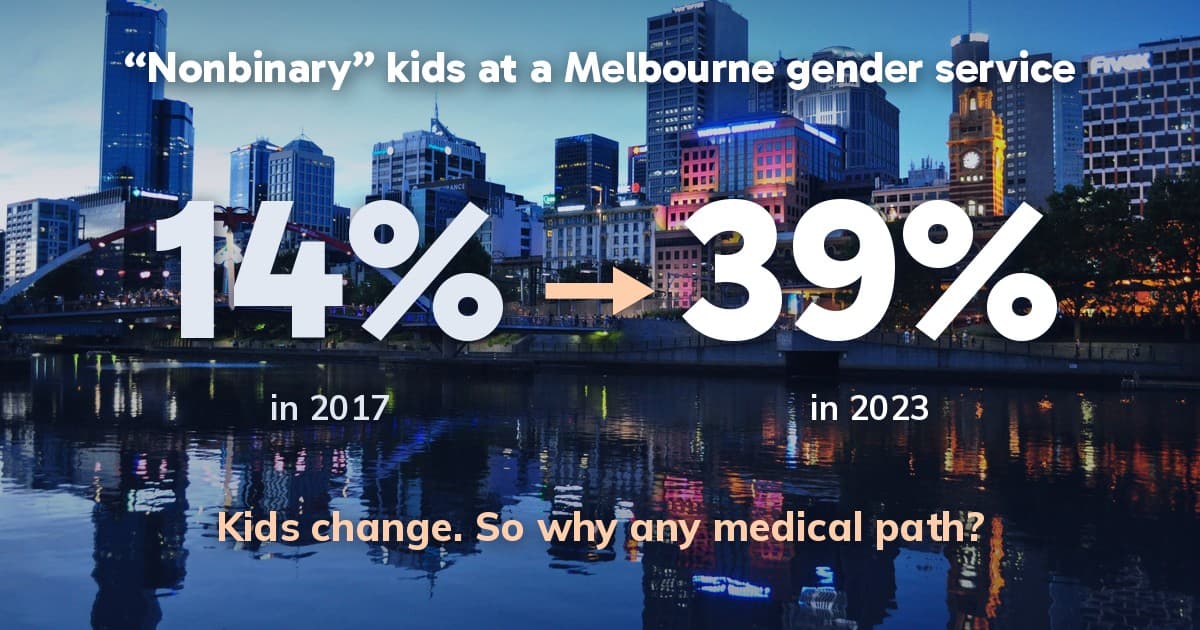
A cross-sectional study in JAMA Pediatrics (Buckingham et al., published Oct. 12) compared patients who call themselves "nonbinary" with those who say they are the opposite sex. According to MCRI, the share of patients who call themselves "nonbinary" rose from 14.2% in 2017 to 39% in 2023. Patients who call themselves "nonbinary" reported somewhat lower body dissatisfaction and a lower rate of desire for medical or surgical changes, though almost all wanted to change at least one body part or feature, most commonly breasts or chest and voice.
"Social transition" over time
A longitudinal study in The Lancet Regional Health – Western Pacific (Conabere et al.) followed 234 children and adolescents aged 8 to 17 over two to three annual waves between 2017 and 2024, tracking changes in name, pronouns and appearance across five settings.
- 56.4% consistently met their "social transition" goals; 22.2% met them by the final wave; 6.0% met them at first but not at the final wave; 15.4% did not meet them.
- 60.7% changed their goals during the study.
- MCRI reports that younger children were more likely to add goals over time.
The authors describe "social transition" as "a dynamic, non-linear process driven by evolving personal goals" and recommend that clinical, policy and research frameworks "move away from rigid definitions of social transition."