

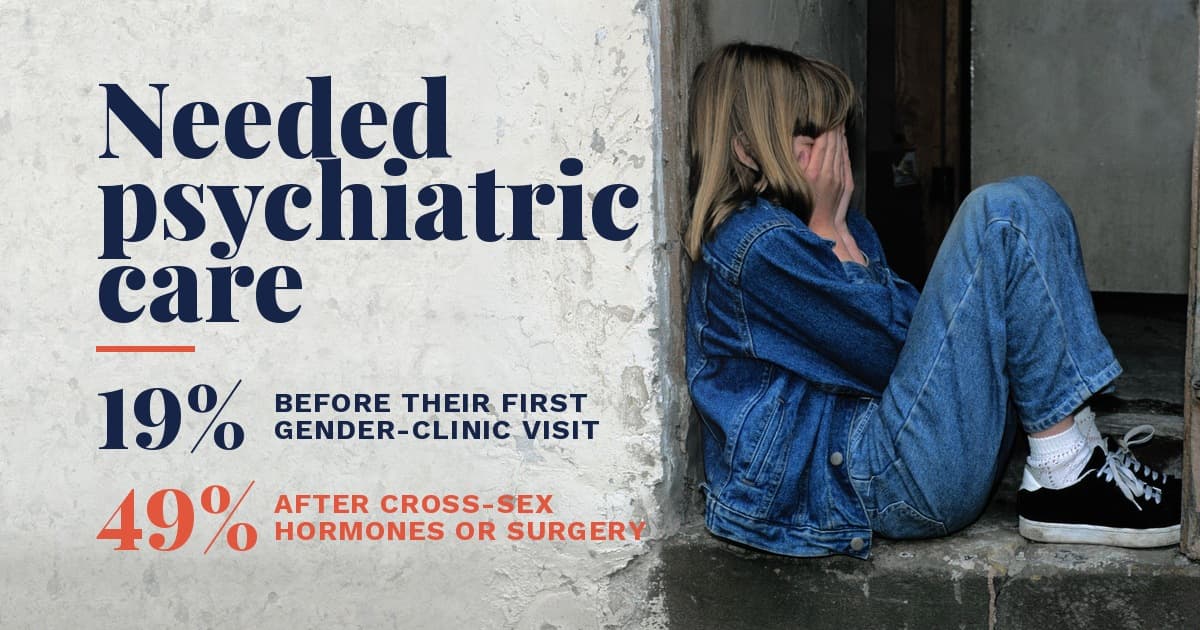
Finnish researchers have published new figures from their nationwide study of young people referred to the country's gender identity clinics. Among those who received cross-sex hormones or surgery, the share needing specialist psychiatric care rose from 19.2% before their first clinic visit to 48.9% after their last procedure.
The study
Sami-Matti Ruuska, Katinka Tuisku, Timo Holttinen and Riittakerttu Kaltiala published the original study in *Acta Paediatrica* in April 2026 (doi:10.1111/apa.70533). In Finland, gender identity assessments that can lead to hormones or surgery are centralized at two university hospitals.
The researchers used national registers to follow all 2,083 people under 23 who attended those clinics between 1996 and 2019. Each was matched by birth year and birth municipality with eight people from the general population, 16,643 in all. Mean follow-up was 5.5 years; the longest was 25 years.
The outcome was specialist-level psychiatric treatment. In Finland, the authors write, such care is reserved for severe mental disorders under national referral criteria. Milder conditions are treated in primary care.
Of the 2,083 people referred, 1,602 were female and 481 were male. 796 (38.2%) received cross-sex hormones, surgery, or both.
Original findings
- Before their first clinic visit, 45.7% of the referred group had received specialist psychiatric care, compared with 15.0% of controls.
- At any point from two years after that visit to the end of follow-up, the figures were 61.7% and 14.6%.
- Among males who received cross-sex hormones or surgery, 9.8% had received specialist psychiatric care before their first clinic visit, and 60.7% received it at some point from two years after that visit onward. For females, the figures were 21.6% and 54.5%. Combined, that is 19.2% before and about 56% after, based on the paper's Table 3.
Those who went on to receive hormones or surgery started with lower rates of psychiatric care than other referred young people. The authors note that severe, unstable psychiatric illness is a reason to delay or withhold treatment in Finland.
The paper concluded: "Psychiatric needs do not subside after medical gender reassignment."
Letters to the journal
Several letters to *Acta Paediatrica* criticized the study. One, a letter of concern, was signed by nearly 50 researchers and clinicians; PsyPost reports it asked the journal to reconsider the paper. Critics argued that psychiatric visits measure use of health care rather than illness, that patients might hide symptoms before approval for treatment, and that the two-year window was too short.
In a May reply, the authors said specialist psychiatric care in Finland is a "robust proxy for current severe psychiatric morbidity," because it is limited to severe disorders and ends once a patient recovers (doi:10.1111/apa.70618). They re-ran the analysis for five or more years after the first clinic visit and reported results consistent with the original. They wrote that the study "does not claim definitive causality" but highlights "the potential for adverse effects in a vulnerable population."
The new analysis
A later letter argued that some people counted as treated may not yet have received hormones or surgery at the time points studied. In a reply published Sept. 15, the authors measured psychiatric care only after each person's latest completed step: specially reimbursed cross-sex hormones, chest surgery, or genital surgery (doi:10.1111/apa.70767).
- Before their first clinic contact, 19.2% of those who received hormones or surgery had a history of specialist psychiatric care, compared with 14.4% of their matched controls.
- After the latest completed procedure, the figures were 48.9% and 13.2%.
After their last procedure, these young people were about six times as likely as the general population to need specialist psychiatric care. That held for both males and females who had the drugs or surgery.
This analysis covers the same group and the same 19.2% starting point as the original paper's figures for those who received hormones or surgery. It counts care only from the latest completed procedure onward, rather than from two years after the first clinic visit. That window starts later and is shorter, which is why its after-treatment figure (48.9%) is lower than the original paper's (about 56% combined).
The authors wrote that this finding "is consistent with both our original report and our subsequent complementary analyses."
Sources
- Ruuska S-M, Tuisku K, Holttinen T, Kaltiala R. "Psychiatric Morbidity Among Adolescents and Young Adults Who Contacted Specialised Gender Identity Services in Finland in 1996–2019: A Register Study." *Acta Paediatrica* 115(7):1545–1553, 2026. doi:10.1111/apa.70533
- Ruuska S-M, Tuisku K, Holttinen T, Kaltiala R. "Response to the Critique by Edmiston et al., Banos et al. and Sandri et al. of Ruuska et al." *Acta Paediatrica* 115(9):2044–2045, 2026. doi:10.1111/apa.70618
- Ruuska S-M, Tuisku K, Holttinen T, Kaltiala R. "Response to the Critique by Banos et al. of Ruuska et al." *Acta Paediatrica*, Sept. 15, 2026. doi:10.1111/apa.70767
- Eric W. Dolan, PsyPost, Oct. 18, 2026
More on this study: Finland register study — Ruuska et al. 2026.
Cover photo: Pixabay via Pexels