

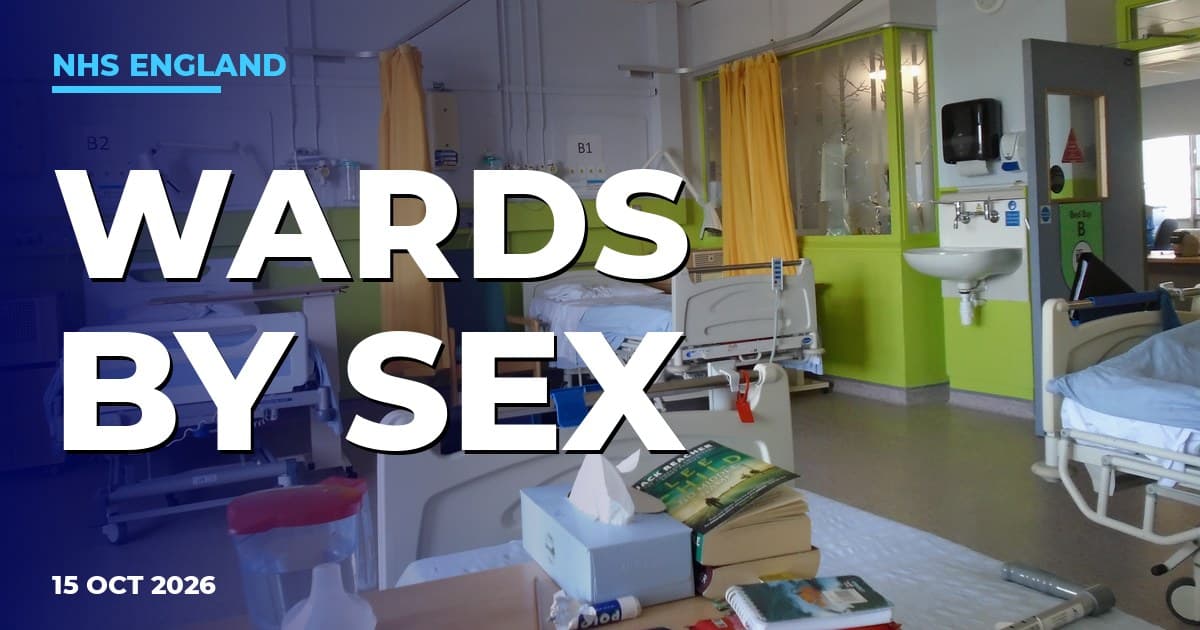
On 15 October 2026 (last updated 16 October 2026), NHS England published Guidance to support NHS organisations in the provision of single-sex services and facilities. The letter tells trusts and integrated care boards that hospital accommodation is to remain single-sex, and that patients are to be placed according to biological sex, including males who identify as women and females who identify as men.
It is addressed to trust and ICB chief executives, chief nurses, chief operating officers, chief people officers, chief financial officers, directors of estates, and medical directors.
The guidance follows the Equality and Human Rights Commission’s statutory Code of practice for services, public functions and associations, which came into force on 5 August 2026.
What NHS England published
NHS England says organisations should now use two documents alongside the EHRC code:
- Privacy, dignity and safety in hospital accommodation — revised guidance on same-sex accommodation for patients
- Guidance on NHS staff facilities — provision and use of staff toilets, changing, washing and shower facilities
Patient accommodation
The letter states that the hospital-accommodation guidance reaffirms the NHS Constitution’s commitment to single-sex accommodation. It then sets the rule under the Equality Act 2010:
“To maintain hospital accommodation as single sex under the Equality Act 2010, trans people and others with the protected characteristic of gender reassignment should be accommodated in line with their biological sex.”
Boards are asked to ensure local policies are consistent with the law and the new guidance, and to keep oversight of plans to meet the NHS Constitution pledge to eliminate mixed-sex accommodation.
Staff facilities
The staff-facilities guidance recommends that organisations review toilets and changing, washing and shower facilities, including staff accommodation with shared (not single-sex) facilities, and consider lockable single-occupancy arrangements. Organisations must still ensure all staff have suitable and sufficient access that protects privacy, dignity and safety.
What boards are asked to do
Chief executives and boards are asked to review both documents at pace and satisfy themselves that the organisation is prepared to respond. Boards should ensure that:
- relevant board-level leads, and those responsible for clinical operations, people, estates and facilities, and communications, review the guidance
- local policies and practices are consistent with the law and the new guidance
- there is a clear plan for any area where change is required
- the board oversees a plan to meet the NHS Constitution pledge to eliminate mixed-sex accommodation
- staff understand what is expected of them and know where to seek advice on complex cases
- arrangements are in place to escalate difficult issues
- organisations continue to foster workplaces that are safe, respectful and inclusive, with clear expectations around dignity and protection from bullying, harassment and discrimination
- plans include monitoring impact and revising decisions when evidence or circumstances change
The letter is signed by Danny Mortimer, Director General, People, NHS England, and Duncan Burton, Chief Nursing Officer for England.
Source
Primary source: NHS England guidance letter, 15 October 2026.
*Cover photo: empty beds in bay B, Evelyn Ward, Northwick Park Hospital, Harrow, 24 March 2020, by Kolforn (Wikimedia Commons), CC BY-SA 4.0. Headline text added.*